What is a temporary workshop?
A temporary workshop is a covered work area for maintenance, assembly, repair, inspection or processing on your own site or project location. You use a temporary workshop when work needs to continue safely and under shelter, without immediately investing in a permanent building.
In practice, it is often a modular and relatively compact solution that can be installed quickly on a construction site, industrial site, logistics location or at a technical service department. This makes a temporary workshop useful when you need extra workspace for a limited period, but also when a semi-permanent work area is more practical than new construction.
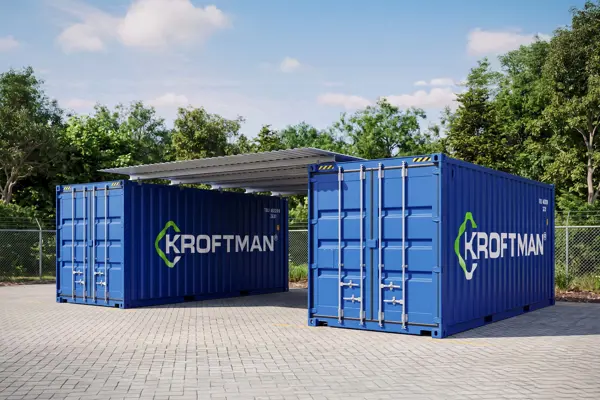
At Kroftman, a temporary workshop consists of a container shelter or Workbox for professional use. A container shelter is often the most practical choice when you want to create a spacious and easily accessible work area. The Workbox can be useful when you need a more compact or more protected workspace.
With the structure, you receive the Buildbook free of charge, including technical documentation. This means you do not only create a practical temporary workshop, but you can also demonstrate that the structure is technically substantiated.
When is a temporary workshop useful?
For many companies, the need for a temporary workshop starts with a practical problem. The existing workshop is full, work takes place outside, a project requires extra space or mechanics and technicians need a sheltered workplace on site.
A temporary workshop is useful, for example, when:
the existing workshop or hall is full
maintenance or repair work takes place outside
extra space is needed for assembly, installation or processing
machines, tools or parts need to stay protected during work
work needs to be less dependent on rain, wind or sun
temporary extra workspace is needed for a project, peak period or maintenance shutdown
you want to create a fixed work area on a construction site or company site
work processes need to be separated more clearly, for example workspace and storage
building a permanent workshop is too expensive, too slow or unnecessary
In these situations, a temporary workshop helps you make better use of outdoor space. You quickly create a usable covered work area that fits the work, the available space and the way your site is organised.
Key benefits
Quickly create extra covered workspace on your own site or project location
Suitable for maintenance, assembly, repair, inspection and processing
Protects employees, tools, machines and parts from rain, wind and sun
Less downtime or relocation of work due to weather conditions
Practical for construction sites, industrial sites, logistics locations and technical services
Suitable as an extension of an existing workshop or as a separate work area on site
Open or more protected version possible
Installation on shipping containers possible
Choice between container shelters and Workbox setups
Modular design and available in different sizes
Suitable for temporary and semi-permanent use
Buildbook with technical calculations and drawings available
Designed for professional use
For companies that regularly work outside, a temporary workshop mainly provides more continuity and overview. Work can continue, tools remain protected and the work area does not have to be set up again and again.
Who is a temporary workshop suitable for?
A temporary workshop is suitable for companies that need extra sheltered workspace on their own site or project location. Often, there is still enough outdoor space available, but there is no practical place to work safely and efficiently.
We often see this need in:
construction companies
installation companies
infrastructure companies
production companies
mechanical engineering companies
maintenance and service companies
technical services
logistics companies
rental companies
industrial companies with project-based work
The application differs per company, but the question is often the same: how do we quickly create a sheltered work area without immediately building a permanent hall or fixed workshop?
Determining the right size and setup
For many customers, the question about a temporary workshop starts with a general space requirement: “we need extra workspace”, “the work needs to continue outside” or “we are looking for a temporary shelter for mechanics, machines and materials”. The next step is translating that need into the right size, setup and version.
Important questions include:
What work do you want to carry out in the temporary workshop?
Is it for maintenance, assembly, repair, installation, inspection or processing?
Which machines, workbenches, tools or auxiliary equipment need to be placed under the shelter?
How much free workspace is needed around employees, equipment and parts?
Do forklifts, telehandlers or service vehicles need to access the workshop?
Do you need an open work area or extra protection with walls?
Is the workshop intended for a temporary project or for longer-term use?
Are there requirements for safety, HSE, ventilation or fire safety?
Kroftman supplies different sizes and versions. Thanks to the modular design, there are several options in width, length, height and finishing. If a standard setup does not fit the situation properly, a suitable configuration can be considered.
Container shelter or Workbox as a temporary workshop
A temporary workshop can be set up in different ways. Which solution fits best mainly depends on the work, the desired accessibility and the level of protection required.
A container shelter is often the logical choice when you are looking for a spacious, practical and easily accessible work area. This solution is suitable when enough room is needed for machines, materials, tools, vehicles or internal transport. Depending on the version, a container shelter can be open or provide more protection, for example with a front wall, back wall, top wall or side wall.
A Workbox is useful when you want to create a more compact or more protected work area. This solution can be suitable when machines, tools, parts or activities need more protection, or when you want to create a clearly separated work zone for temporary or semi-permanent use.
The right choice therefore depends not only on whether the solution should be open or closed, but mainly on the type of work, the available space on site and the desired layout of the work area.
Structure, documentation and permits
A temporary workshop must work in practice, but it also needs to be technically assessable. Kroftman shelters are designed for professional use and are calculated in accordance with EN 13782. With the structure, you receive the Buildbook free of charge, including technical calculations and drawings.
Depending on the chosen version, the temporary workshop consists of a galvanized steel structure with a strong cover, or a Workbox setup with galvanized S390 steel. The right version depends on the required size, application, level of protection and duration of use.
The Buildbook can be used for internal assessment, project documentation or a possible permit application. Additional technical specifications, assembly instructions and product documentation are also available.
Whether you need an environmental permit for a temporary workshop depends on your location, the dimensions, the duration of use and local regulations. Always check this in advance with your municipality or via the official permit portal.

 Nederland
 België
 United Kingdom
 Deutschland
 Österreich