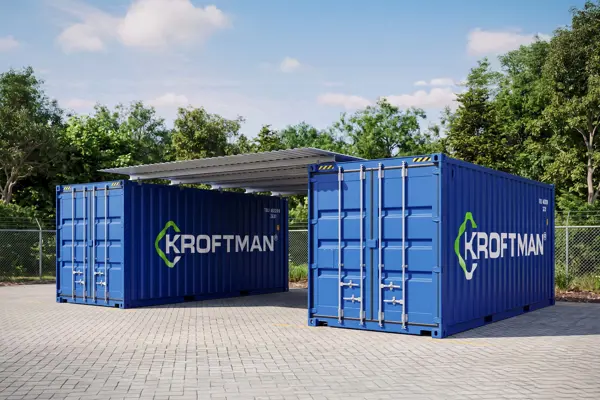
What is a saw shed?
A saw shed is a covered work and storage area for sawing, processing and temporarily storing timber or wood materials. You use a saw shed when wood, sheet material, sawn parts, machines and tools need to be protected from rain, wind and sun, while the work takes place outside or on a company site.
For timber processing, shelter is important. Wood that is stored outside is exposed to moisture, dirt and changing weather conditions. This can affect the quality, dimensional stability and workability of the material. With a saw shed, you create a fixed, covered area where timber can be kept dry, machines can be positioned under shelter and sawing work can be organised more efficiently.
At Kroftman, a saw shed is not a traditional permanent building, but a modular solution for quickly creating extra covered space for timber processing and timber storage. Depending on the situation, this can be done with a container shelter or a Workbox setup on shipping containers. This creates a practical area for sawing, preparation, sorting, temporary storage or a fixed work zone next to the existing workshop or warehouse.
With the shelter, you receive the Buildbook free of charge, including technical documentation. This means you do not only place a practical saw shed, but you can also demonstrate that the structure is technically substantiated.
When is a saw shed useful?
For companies that work with timber, the need for a saw shed usually starts with a practical problem on site. Timber is stored outside and gets wet, the existing workshop is full, sawing work depends too much on the weather or materials are spread across the site, making work less efficient.
For example, when:
the existing workshop or storage area is full
timber is stored outside and needs protection from rain and moisture
sawing work takes place outside and depends too much on the weather
wood needs to stay dry before further processing, assembly or delivery
machines, saw tables or tools need to be protected
you work with long lengths, timber packs or sheet material and want loading and unloading under cover
a project, peak period or seasonal stock temporarily requires more space
building a permanent shed is too expensive, too slow or simply unnecessary
In these situations, a saw shed helps turn outdoor space into a usable covered work and storage area. It gives you more control over timber storage, sawing work and internal logistics without immediately investing in a permanent building.
Key benefits
A saw shed is especially useful when timber needs to remain dry, organised and easy to access. The main benefits are:
Quickly create extra covered space for timber processing and timber storage
Suitable for sawing, sorting, preparing, processing and temporarily storing timber
Protects wood, machines and tools from rain, wind and sun
Helps keep timber dry and organised on your own site
Practical for sheet material, beams, planks, sawn parts and wooden components
Less disruption or relocation of work during bad weather
More structure in the storage, processing and movement of timber
Suitable as a temporary or semi-permanent extension of the workshop
Installation on shipping containers possible
Choice between container shelters and Workbox setups
Modular design with different sizes and versions available
Free Buildbook with technical calculations and drawings available
Suitable for professional use on construction sites, sawmills, workshops and company sites
For companies that work with timber on a daily or regular basis, a saw shed mainly creates order and efficiency. Timber is no longer spread across the site, machines are positioned under shelter and employees have a clear place to carry out sawing and preparation work.
Who is a saw shed suitable for?
A saw shed is suitable for companies that store, saw, process or prepare timber and need extra covered space on their own site. Often, there is still enough outdoor space available, but without shelter that space is not practical for dry sawing work or timber storage.
We often see this need in:
sawmills
timber processing companies
carpentry companies
joinery workshops
timber merchants
timber storage locations
prefab and timber frame construction companies
construction companies with a fixed sawing or preparation area on site
workshops that process sheet material, beams, planks or packaging timber
industrial companies that use wooden pallets, formwork, crates or wooden components
For these companies, a saw shed is useful when timber needs to stay dry and work should not stop every time the weather changes. The shelter makes it possible to use outdoor space as a fixed area for sawing, storage, preparation or material handling.
Timber processing and timber storage under one shelter
A saw shed is often used for more than just sawing. In practice, the space is also used for storage, sorting, preparation and temporarily setting aside timber for the next step in the process. This may involve beams, planks, sheet material, wooden components, prefab elements or packaging timber.
By combining timber storage and timber processing under one shelter, you create a more logical workflow. Timber can be stored under cover, processed nearby and then kept dry until it is needed for assembly, transport or further work. This reduces unnecessary movement across the site and makes the work area easier to manage.
A saw shed can be used for:
dry storage of timber and sheet material
sawing beams, planks or wooden components
preparing wood for assembly, construction or prefab work
sorting and setting aside material per project
positioning machines, saw tables or workbenches under shelter
temporarily storing processed timber
protecting tools, equipment and auxiliary materials
For timber, the combination of shelter, accessibility and overview is especially important. The space must be large enough to move materials safely, but also practical enough to position machines, storage and transport routes in a logical way.
Determining the right size and setup
For many customers, the question starts with a practical space requirement: “we want to saw outside under cover”, “our timber needs to stay dry” or “we need extra space next to the existing workshop”. The next step is translating that need into the right size, height, accessibility and setup.
Important questions include:
What type of timber do you want to store or process?
Are you working with beams, planks, sheet material, prefab components or a combination?
Do you mainly need storage space, work space or a combination of both?
Which machines, saw tables, workbenches or roller conveyors need to be placed under the saw shed?
How much free space is needed around machines and materials?
Do forklifts, telehandlers or pallet trucks need to access the shelter?
Will loading and unloading take place from the front, the side or both?
What timber lengths do you work with?
Is extra protection needed with a back wall, side wall, front wall or roller door?
Is the saw shed needed temporarily or for long-term use?
Are there internal safety, HSE or fire safety requirements?
Kroftman supplies different sizes and versions. Thanks to the modular design, there are many options in width, length, height and finishing. If a standard size does not fit your timber flows or available space on site, we think along with you about a suitable configuration.
Container shelter or Workbox as a saw shed
A saw shed can be set up in different ways. Which solution fits best depends on the work, the required level of protection and the way timber is stored or processed.
A container shelter is often the logical choice when you want an open, easily accessible work and storage area. This solution is practical for timber storage, sawing work, loading and unloading, and handling longer lengths of timber. Because the space remains open and accessible, machines, materials and vehicles can be used efficiently.
A Workbox is useful when you need a more compact and more enclosed work or storage area. The Workbox can be used when machines, tools or materials need more protection, or when you want to create a fixed work area for long-term temporary use. The Workbox structure is made of galvanized S390 steel.
In short:
Container shelter as a saw shed
Suitable for open timber storage and sawing work
Practical for long timber lengths and frequent loading and unloading
Plenty of free space for machines, materials and internal transport
Suitable as a temporary or semi-permanent work area
A logical choice when accessibility is important
Workbox as a saw shed
Suitable for a more compact work and storage area
More protection possible with walls or closure
Useful for machines, tools and fixed workstations
Galvanized S390 steel structure
Practical when the sawing area needs to be more enclosed
The right choice therefore depends not only on size, but mainly on use. For open storage and processing, a container shelter is often the best fit. For a more enclosed work area, a Workbox may be more suitable.
Safe and practical working in a saw shed
A saw shed provides shelter, but the layout of the work area remains important. During timber processing, wood dust, sawdust, offcuts and traffic movements often come together in one place. That is why it is useful to think carefully about routing, machine setup and storage before placing the shelter.
Practical points to consider include:
keep the sawing area, timber storage and walking routes clearly separated
position machines so timber can be fed in and out in a straight line
keep enough free space around saw tables, workbenches and roller conveyors
prevent offcuts and sawdust from building up in the work area
consider dust extraction or local extraction at woodworking machines
provide sufficient ventilation and lighting
allow for forklift or telehandler traffic
store timber clearly so material remains easy to find
avoid placing timber directly on a wet surface
include internal safety and fire safety requirements in the layout
A good saw shed is therefore more than just a roof over the work area. Its value lies in the combination of shelter, overview and a practical layout. This helps align timber, machines and employees more effectively.
Structure, documentation and permits
A saw shed must work in practice, but it also needs to be technically assessable. Kroftman shelters are designed for professional use and are calculated in accordance with EN 13782. With the structure, you receive the Buildbook free of charge, including technical calculations and drawings.
Depending on the chosen version, the saw shed consists of a galvanized steel structure with a strong cover, or a Workbox setup with a galvanized S390 steel structure. The right version depends on the required size, application, level of protection and duration of use.
The Buildbook can be used for internal assessment, project documentation or a possible permit application. Additional technical specifications, assembly instructions and product documentation are also available.
Whether you need an environmental permit for a saw shed depends on your location, the dimensions, the duration of use and local regulations. Always check this in advance with your municipality or via the official permit portal.
Kroftman’s technical documentation can help with internal assessment, project preparation or a possible permit application.

 Nederland
 België
 Europe
 Deutschland
 Österreich