


Frequently asked questions

What if something is missing from my order?
1 min reading time
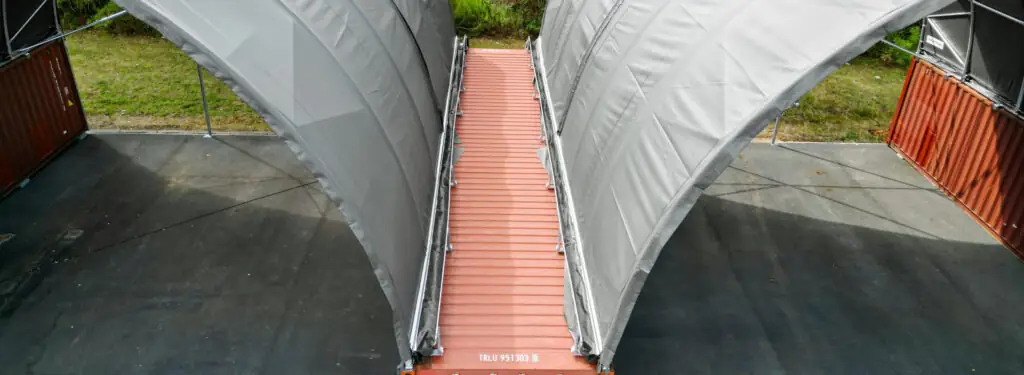
Shelters are used in locations where work must be able to continue regardless of the weather. This includes outdoor storage of materials, processing operations or covering waste streams. The aim is always the same: to keep materials, equipment or work areas as dry and usable as possible.
As shelters become larger, the roof surface also increases. In heavy rain, a lot of water can therefore accumulate on containers or concrete walls. If this water is not drained off in a controlled way, there is a risk that it will still end up underneath the shelter.
In this blog, you will learn when this risk arises, how it manifests itself in different configurations and what role a rain gutter can play in environmental protection.
The rain gutter was developed as an addition to our shelters and is supplied as standard in grey. If you would like to know whether a rain gutter is suitable for your setup, you are welcome to discuss it with our sales department. They will review it based on your specific situation and application.
In this video, Dineke shows how the rain gutter is constructed and how it is used with our shelters.
At a building materials manufacturer, several bunker silos are used for the storage of gravel, sand and recycled concrete aggregate. In such situations, the aim is to reduce the ingress of rainwater as much as possible in order to:
ensure that the stored batches do not become too wet or contaminated

In this setup, three CTA1012 bunker-silo shelters have been installed in a row, with a total length of 36 metres. Directly next to this row there is an identical arrangement. This results in:
By installing a rain gutter between the two rows, the rainwater is collected centrally and discharged in a controlled manner behind the shelters.
A manufacturer of industrial fans, water cooling systems and noise control solutions required additional covered storage space for materials. For this purpose, two CTA1012 container shelters were installed next to each other.
Due to the larger combined roof surface:
To prevent this, a rain gutter was also installed here to direct the water flow away from the storage area.
Do you have questions about rainwater drainage for outdoor storage? We will be happy to support you in optimally tailoring your shelter and water drainage to your situation.

Frequently asked questions
1 min reading time
Frequently asked questions

6 min reading time
Frequently asked questions

2 min reading time
From $638.09
Temporary storage
or work space in
an instant
From €2790
Temporary storage
or work space in
an instant
From $9.216,78
Self-built sheds
without concrete
foundation
From $5.339,38
Flexible
industry-quality
storage space